
Shareling is an app to share links with friends one person at a time: you send a link straight to one friend, and it lands in both your libraries. It runs on Mac, iPhone and iPad, and it replaces the old routine of sending links through Messages, X and LinkedIn and parking the good ones in Chrome bookmarks.
Sending to a person is designed but not built yet. Everything below describes how Shareling works at launch, taken from the product's design decisions, its vocabulary file and its design boards. None of it is in the app you can use today.
What is Shareling for?
Shareling is for two people who send each other links and want to find them again. A link someone sends you in a chat sits inside that one conversation. In Apple's Messages, the Links category is per conversation, and the only other way Apple documents to single a link out is to pin it. If either person sets Keep Messages to 30 days or 1 year, older conversations and their attachments are deleted from that person's devices.
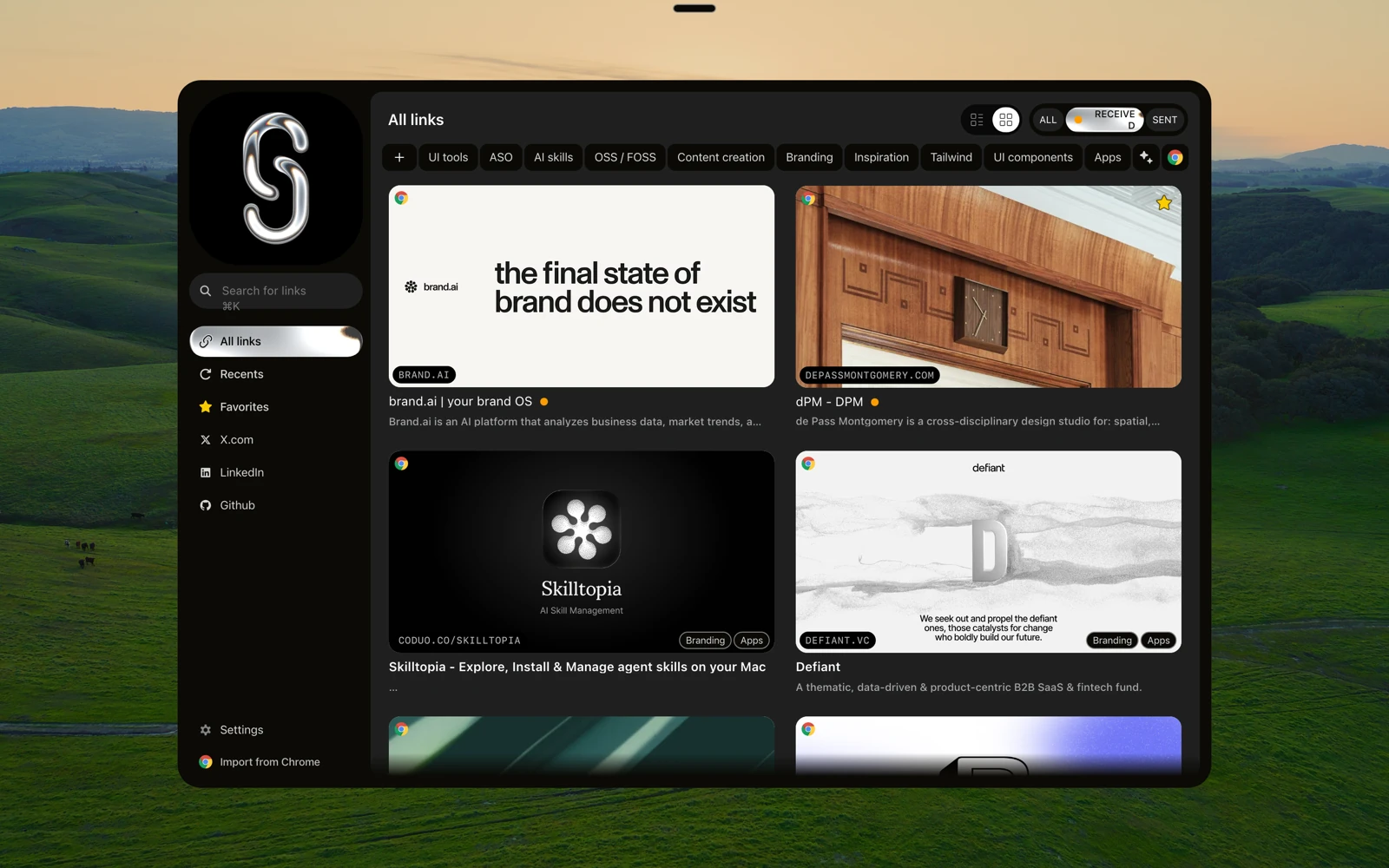
Shareling keeps every link you send or receive in one library. Sent and Received are filters over it, next to All Links and Recents, and a link that reaches you more than once shows up once. You can file links in folders, which work like tags: one link can sit under two projects. The same library holds links you keep for yourself.
Shareling runs on macOS, iOS and iPadOS 26 or later.
How do I send a link to one specific person?
You drop the link on that person. On the Mac, the design has you drag a link to the top of the screen, where a capsule by the notch opens and shows the people you share with. There are three places a drop can land:
- A person. The link is sent to them.
- Self. The link is kept in your own library and goes to nobody.
- New person. The drop starts an invite to someone you have not shared with yet.
After the drop, the capsule offers a field to add a note or add the link to a folder.
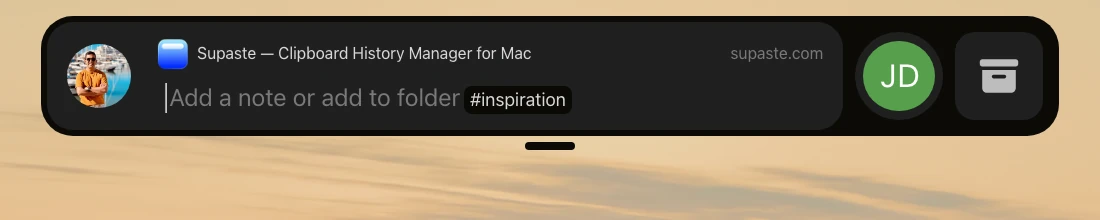
One drop goes to one destination. There is no multi-select and no way to address several people at once, so sending a link to three friends takes three drops, which also produces three separate records. Each of those three can carry a different note. Your library still shows the link once, because it matches links by a canonical form of the URL.
Sending also puts the link in your own library, under Sent, and receiving puts it in your friend's, under Received. Neither is a second copy: both follow from where the link is stored (see the section on data below).
What does the other person see, and what stays private?
Your friend sees the link and the note you wrote when you sent it; everything else you attach stays with you. The note is a field on the link, written once at send time, and it is the channel for anything you mean them to read.
What never travels:
- Folders. Folders are private to whoever applied them. Your friend can file the same link under their own folders, and you will not see those either. The design reasoning is that filing is only honest when nobody is watching.
- Favorites and read later. Both are private flags in your own record about the link, in your own zone.
- Whether you opened it. Read state lives in the recipient's private zone. Shareling does not notify a sender when a link is read or saved. The design keeps it that way on purpose: telling the sender would have to be a deliberate product decision, never a side effect of where a field is stored.
What you do see is your own unread count. Shareling counts unread links overall and per person, and it marks a link read only when you click it. Opening the capsule marks nothing, and marking everything read is a manual action you choose.
Where is the data kept?
The data is kept in each person's own iCloud, using Apple's CloudKit. Every link exists exactly once, in the zone of whoever sent it:
- A channel is a CloudKit zone owned by the sender and shared with one recipient.
- A friendship is two channels, one for each direction, so each of you owns the links you sent.
- Your library is a view, not a separate store: your private zone, the zones you own, and the shared zones you take part in, combined.
- Your folders, read state and hidden links sit in one private record per link in your own zone, so nothing you do to a friend's link is written into their zone.
- Preview images are fetched again on each device rather than stored in iCloud, so links carry no stored images and sharing stays cheap for the sender, who owns the records.
The live iCloud connection is not in the current code: the architecture notes list the CloudKit transport and share creation as a later piece of work.
What happens if I unsend a link or remove a person?
Unsend deletes a link you sent, and you have one hour to do it; removing a person keeps everything they sent you. The design treats these as three separate acts:
| Act | Who can do it | What it does |
|---|---|---|
| Hide | Either person, any time, including on links you sent | Hides the link from your view. Nothing is deleted. |
| Unsend | The sender, within 1 hour | Deletes the link. It leaves no marker behind. |
| Remove person | You, for anyone you share with | Ends the channel. Nothing you received is lost. |
The one-hour window is short for a reason. Because a link exists only once, in the sender's zone, there is no copy on your friend's side to survive an unsend. The hour is a promise the app keeps in its interface, not a storage guarantee: the owner of a zone can always delete their own records.
Removing a person works as copy-before-revoke. Shareling copies the links they sent you into your private zone, checks the copy, and only then revokes both shares. Each copied link keeps a snapshot of the sender's display name, and the copy can resume if it stops halfway. Your library looks the same afterwards. This is the only time Shareling copies a link; in normal use it never does.
How a link gets sent has its own pages: the notch drop on the Mac, and the share sheet on iPhone and iPad.
Plans and pricing are on the plans page.
Frequently asked questions
Can I send one link to several friends at once in Shareling?
No. Shareling is designed so that one drop goes to one person. Sending a link to three friends takes three drops, and each one can carry its own note.
Will my friend see my folders on a link I send?
No. Folders in Shareling are private to the person who applied them and never travel. The note you write when you send the link does travel, and it is the one place to put context meant for your friend.
Does Shareling tell me when my friend opens a link?
No. Whether a link has been read is stored in the recipient's own private iCloud zone, so the sender is never told when a link is opened or saved.
Can I take back a link I sent to someone?
Yes, within one hour. Unsend deletes the link, and the one-hour limit is a promise the app keeps in its interface rather than a limit in iCloud storage. Either side can also hide a link at any time, which removes it from view without deleting anything.
Can I send links with Shareling today?
Not yet. Sending to a person, invites, the notch drop, Unsend and Remove person are designed but not built, and the live iCloud connection that carries links between two people is planned for a later release.
Send a link to the person you mean it forShareling is a Mac, iPhone and iPad app for sending a link to one person and keeping the links you save, synced through your own iCloud.